Are you confident you can spot a high-quality niche edit opportunity from a worthless or even harmful one? In a digital landscape where every backlink counts, making the wrong choice can waste your budget and damage your search rankings. This guide provides the definitive framework for separating valuable link insertions from the junk.
Vetting niche edit sites involves a systematic review of a website's SEO health, content quality, and backlink profile to ensure it's a safe and effective place to acquire a link. The process requires analyzing metrics like Domain Rating (DR) and organic traffic, assessing topical relevance, and scrutinizing outbound link patterns to avoid private blog networks (PBNs) and low-quality link farms. A thorough vetting process is the only way to guarantee a positive return on your link building investment in 2026.
What Are Niche Edits and Why Do They Matter?
A niche edit, also known as a link insertion or curated link, is the process of adding a contextual backlink to an existing, aged article or blog post on another website. Unlike a guest post where you provide entirely new content, a niche edit leverages the power and authority of a page that is already indexed, often ranking, and has its own backlink profile. This makes them a powerful and efficient tool in an off-page SEO arsenal.

The primary advantage of a niche edit is speed and immediate impact. Because the content is already established, the link you add can pass authority and relevance to your site almost instantly. This is particularly valuable in competitive industries like finance, crypto, and iGaming, where building authority quickly is a significant advantage. However, this power comes with a risk, which is why learning how to vet niche edit sites: a quality checklist for buyers is not just recommended, it's essential for campaign success and safety.
Niche Edits vs. Guest Posts: Understanding the Key Differences
While both niche edits and guest posts are effective link building tactics, they serve different strategic purposes and have distinct workflows. A guest post involves creating and publishing a brand-new article on a third-party site, giving you control over the content and anchor text. A niche edit, conversely, is about finding a relevant, existing piece of content and persuading the site owner to insert your link naturally within it.

Understanding these differences helps you decide which strategy is right for your campaign goals. Niche edits are often faster to implement and can provide a quicker SEO boost by tapping into the existing authority of an aged page. Guest posts offer more brand control and can be used to build thought leadership. Many successful campaigns use a mix of both. For a deeper dive, you can explore the strategic differences between niche edits vs guest posts to build authority faster.
| Feature | Niche Edits (Link Insertions) | Guest Posts |
|---|---|---|
| Content | Link is added to existing, aged content. | Entirely new article is written and published. |
| Placement | Contextually within an established article. | A new, standalone page on the target site. |
| Speed | Generally faster to acquire and see impact. | Slower process involving content creation and approval. |
| SEO Impact | Leverages existing page authority for quick value. | Builds authority from scratch as the new page ages. |
| Control | Less control over surrounding content and anchor text. | Full control over the article and link placement. |
Your Quality Checklist for Vetting Niche Edit Sites
Not all niche edit opportunities are created equal. A link from a high-quality, authoritative site can significantly boost your rankings, while one from a low-quality site or PBN can result in a Google penalty. To protect your investment and your website's integrity, you must perform due diligence. This checklist provides a systematic framework for evaluating every potential link placement.
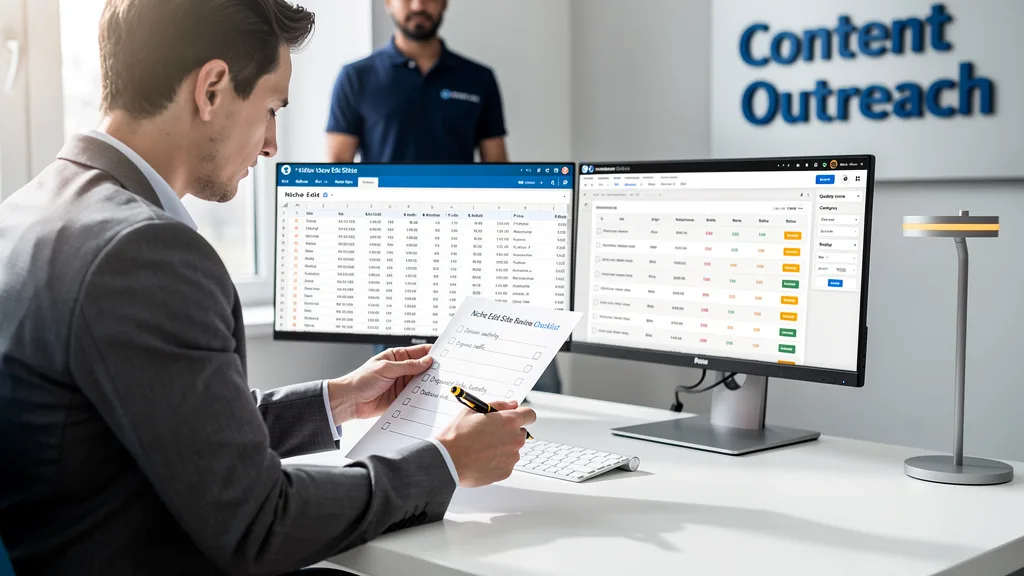
By following a consistent vetting process, you remove guesswork and emotion from the decision. Each step is designed to uncover a different aspect of the target site's quality, from its raw authority metrics to the subtler signs of a healthy, editorially-driven website. This disciplined approach is the key to building a powerful and penalty-proof backlink profile.
Analyze Core Site-Level SEO Metrics
The first step in your vetting process is to analyze the core SEO metrics of the target domain. These numbers provide a high-level overview of the site's authority and health in the eyes of search engines. While no single metric tells the whole story, together they paint a clear picture of whether a site is worth pursuing further.
Start by looking at metrics like Ahrefs Domain Rating (DR) or Moz Domain Authority (DA). Aim for sites with a DR of 30 or higher, though this can vary by niche. More importantly, check the organic traffic figures using a tool like Ahrefs or Semrush. A quality site should have substantial, stable, or ideally, growing organic traffic. A site with high DR but zero traffic is a major red flag, often indicating it's part of a PBN or has been penalized.
Evaluate On-Page Content Quality and Relevance
Once a site passes the initial metrics check, it's time to perform a manual review of its content. A machine can't tell you if a site is truly relevant to your audience or if its content is genuinely helpful. The website's primary topics should align with your own. A link from a relevant site passes more powerful signals to Google.
Read through several articles. Is the content well-written, informative, and free of grammatical errors? Does the site publish content regularly, or was the last post from three years ago? A stale, neglected site offers little value. The specific article where your link would be placed must be topically relevant to your target page. Forcing a link into an unrelated article is a spammy practice that Google can easily devalue.
Scrutinize the Website's Backlink Profile
A website is only as strong as its own backlink profile. A site with a high DR might have achieved it through spammy means, and you don't want your site associated with that. Use a tool like Ahrefs to analyze the referring domains pointing to the target site. Look for links from other real, authoritative websites in the same or related niches.
Red flags in a backlink profile include a high number of links from low-quality directories, foreign language sites, or known PBNs. The anchor text distribution should also look natural, with a healthy mix of branded, naked URL, and generic anchors, not just keyword-stuffed phrases. A clean, powerful backlink profile is one of the strongest indicators of a quality niche edit opportunity.
Check for a Natural Outbound Link Footprint
How a site links out to others is just as important as how other sites link to it. Many low-quality sites and PBNs exist solely to sell links. They often have an unnatural outbound link footprint that is easy to spot if you know what to look for. Manually inspect a few articles to see what kinds of sites they link to.
A natural site links out to a variety of authoritative resources, helpful guides, and relevant sources to add value for the reader. A link farm, on the other hand, will almost exclusively link out to commercial "money" pages with exact-match anchor text. If you see a blog post about "best dog food" that links out to ten different casino and payday loan sites, run the other way. This indicates the site owner will sell a link to anyone, and its authority is likely to be non-existent or fleeting.
Red Flags: How to Identify a PBN or Low-Quality Site
Identifying low-quality sites and PBNs is a critical skill for safe link building. These sites are designed to manipulate search rankings and carry a high risk of being devalued or penalized by Google. Learning to spot their common characteristics will protect your website from toxic associations. Your vetting process should actively screen for these warning signs.

Here are some of the most common red flags to watch for:
- Sudden Traffic Drops: A sharp, unrecovered decline in organic traffic often signals a Google penalty.
- Suspicious Outbound Links: The site links out to many unrelated, low-authority, or "bad neighborhood" sites (e.g., casinos, pharma).
- Thin or Poorly Written Content: Articles are short, generic, and offer little real value. Many may be written by AI with no human editing.
- No "About Us" or Contact Info: Legitimate businesses are transparent. PBNs are often anonymous.
- Stock Photo Authors: The author bios use generic stock images and have no social media presence or verifiable history.
- "Write for Us" Page Sells Links: A page that openly advertises selling links or has a price list is a clear sign of a link farm, not a real publication. This is different from a page that outlines editorial guidelines.
These signs often appear together, creating a clear picture of a site to avoid. Understanding the differences between various link types, like in this PBNs vs guest posts vs niche edits guide, can further sharpen your judgment.
Essential Tools for Your Vetting Process in 2026
Performing a thorough analysis requires the right set of tools. While manual inspection is irreplaceable, SEO software provides the data you need to make informed decisions quickly. Investing in a professional toolkit is non-negotiable for anyone serious about building high-quality backlinks at scale. These tools give you access to link indexes, traffic estimates, and historical data that are impossible to find otherwise.
For a comprehensive vetting process in 2026, your toolkit should include:
- Ahrefs: The industry standard for backlink analysis, DR checks, and organic traffic estimation. Its Site Explorer tool is indispensable for scrutinizing referring domains and outbound link profiles.
- Semrush: An excellent all-in-one suite that provides robust organic traffic data, keyword rankings, and a toxicity score for backlink profiles. Its traffic trend graph is particularly useful for spotting penalties.
- Moz Pro: Known for its Domain Authority (DA) metric, Moz also offers useful tools for analyzing a site's link profile and on-page optimization.
- Majestic: Specializes in backlink intelligence, offering unique metrics like Trust Flow and Citation Flow, which help gauge the quality and quantity of links pointing to a site.
Using a combination of these tools provides a more balanced and accurate view than relying on a single data source. Cross-referencing traffic data and backlink profiles between Ahrefs and Semrush, for example, can help you verify your findings and increase your confidence in a decision.
How Much Should You Pay for a High-Quality Niche Edit?
Pricing for niche edits can vary dramatically, and understanding the market rates is key to getting fair value without overpaying or falling for a scam. In 2026, the cost of a single high-quality niche edit can range from $150 to over $1,000. This wide range is influenced by several key factors, and the cheapest option is rarely the best.
The primary drivers of cost are the website's authority (DR/DA), the amount of organic traffic it receives, and its topical relevance. A link on a DR 70+ website with 100,000+ monthly organic visitors in the competitive finance niche will command a premium price. Conversely, a link on a DR 35 general blog with 5,000 monthly visitors will be much more affordable. Be wary of providers offering links on high-DR sites for less than $100; these are almost certainly part of a PBN or link farm, and the advertised metrics are likely inflated or meaningless.
"When you're evaluating the cost of a niche edit, you're not just paying for a link; you're investing in the site's established authority, traffic, and trust signals. A cheap link from a poor-quality site isn't a bargain, it's a liability. True value lies in finding placements on genuinely authoritative sites, and that requires a proper budget and a thorough process for vetting niche edit sites."
Risks vs. Rewards: Are Niche Edits Still Effective for SEO?
Given the need for such a rigorous vetting process, it's fair to ask whether niche edits are still a worthwhile strategy in 2026. The answer is a resounding yes, but with a major caveat: they are only effective and safe when done correctly. The rewards of a well-placed niche edit are significant. You can gain a powerful, relevant backlink on an authoritative page, leading to faster ranking improvements than many other methods.
The risks, however, are just as real. Buying links from low-quality sites, PBNs, or link farms can lead to your link being devalued or, in a worst-case scenario, a manual action (penalty) from Google that tanks your traffic. This is why the entire process hinges on quality control. The effectiveness of the tactic is directly proportional to your ability to vet opportunities and reject bad ones. By following a strict checklist and learning how to buy niche edits without getting burned, you can confidently minimize the risks while maximizing the rewards.
Key Takeaways
Mastering the art of vetting niche edit sites is a crucial skill for any serious SEO. It transforms link building from a gamble into a strategic investment. By internalizing a quality-first mindset, you can build a powerful backlink profile that drives sustainable growth and withstands algorithm updates. Remember that the goal is not just to acquire links, but to earn placements on real, authoritative websites that Google trusts.
Here are the most critical points to remember from this guide:
- Traffic is King: A site's stable or growing organic traffic is a more reliable indicator of health than authority metrics like DR or DA alone.
- Relevance Matters: The link must be placed on a site and within an article that is topically relevant to your target page.
- Inspect the Neighborhood: Always scrutinize a site's inbound and outbound link profiles. Who they link to and who links to them reveals their true quality.
- Manual Review is Non-Negotiable: Tools provide data, but only a human eye can judge content quality, site design, and the subtle red flags of a PBN.
- Price Reflects Quality: Be suspicious of cheap offers. Legitimate, high-quality placements require a realistic budget.
Frequently Asked Questions
What SEO metrics matter most for a quality link insertion?
The most important metrics are a combination of authority and performance. Look for a site with stable or growing organic traffic (viewed in Ahrefs or Semrush), as this shows Google currently trusts the site. After that, consider the Domain Rating (DR) or Domain Authority (DA) as a general measure of its backlink profile strength. Finally, page-level relevance is crucial; the specific article must be topically aligned with your content.
No single metric should be used in isolation. A site with a high DR but zero traffic is a huge red flag. A holistic view that combines traffic trends, authority scores, and manual content review is the only reliable way to assess the quality of a potential niche edits & link insertion service placement.
Is Ahrefs DR or Moz DA more reliable for judging a site's authority?
Both Ahrefs' Domain Rating (DR) and Moz's Domain Authority (DA) are third-party metrics designed to estimate a website's authority based on its backlink profile. In the SEO industry, Ahrefs DR is often considered slightly more reliable due to its larger and more frequently updated link index. However, neither is an official Google metric.
The best approach is not to fixate on the absolute number of either metric. Instead, use them as a preliminary filter and pay more attention to the overall trend. A site with a DR of 40 that is steadily growing traffic is far more valuable than a site with a DR of 60 whose traffic is in freefall. Use the metrics as a guide, but let traffic and manual review make the final call.
What are some effective alternatives to buying niche edits?
While niche edits are powerful, a well-rounded link building strategy should be diverse. Effective alternatives include traditional guest posting, where you contribute a new article to another site. Another popular method is broken link building, which involves finding dead links on a site and offering your own content as a replacement. Creating unique, high-value linkable assets like original research, free tools, or comprehensive guides can also attract natural links.
For those looking for scalable results, working with a service that offers diverse options is key. For example, a campaign might include a mix of PBN links for raw power, guest posts for brand presence, and niche edits for leveraging existing page authority. Considering monthly link building packages can help you implement a balanced strategy over time.
Who are some reputable niche edit service providers?
Identifying a reputable niche edit provider involves the same vetting you would apply to a website. A trustworthy provider will be transparent about their process, prioritize quality over quantity, and refuse to place links on sites that don't meet strict criteria. They should be able to provide case studies or examples of their work and explain their quality control checklist.
Look for specialists who understand the nuances of difficult niches and focus on delivering safe, effective links. At Kamaal SEO, we pride ourselves on a rigorous vetting process that ensures every placement, including our niche edits & link insertion service, enhances our clients' authority and protects them from risk. Always choose a partner who acts as a consultant, not just a link seller.
Conclusion
Ultimately, the success of your niche edit campaigns in 2026 rests entirely on your ability to perform rigorous due diligence. This guide provides a comprehensive checklist, but it's the consistent application of these principles that separates high-impact link building from a risky waste of budget. By prioritizing real traffic, topical relevance, and clean link profiles, you can harness the full power of niche edits to accelerate your SEO results safely.
Ready to build a powerful backlink profile with links that actually move the needle? Our team of specialists applies this rigorous vetting process to every link we build, ensuring maximum impact for clients in competitive niches like finance and crypto. Let us handle the complexities of outreach and quality control for you. Get a Link Plan today and see how our data-driven approach can elevate your domain's authority.