
Are you struggling to gain visibility in the hyper-competitive real estate market? You've optimized your listings and published local content, but your site is still buried on page three of Google. This guide explores a powerful, albeit controversial, strategy that many top agencies consider: PBN link building for real estate.
PBN link building for real estate involves creating or using a private blog network (PBN), which is a group of authoritative websites, to build backlinks to your main property or agency website. The goal is to pass link equity, or "link juice," from these established domains to your target site, thereby improving its search engine rankings for valuable keywords. When managed correctly by experts, this can provide a significant competitive advantage.
This tactic requires deep technical expertise to avoid Google penalties, as it falls into a gray area of SEO. Success hinges on eliminating footprints, creating high-quality content, and ensuring the network appears entirely natural. For those in high-stakes industries like real estate, understanding the mechanics of PBNs is critical before deciding if it's the right approach for your business.
PBN link building is an advanced SEO technique that leverages a network of websites you control to strategically pass authority to a single target website, such as your real estate agency's main site. Unlike conventional link building that relies on outreach, this method gives you complete control over the quantity, quality, and anchor text of your backlinks. In a field as competitive as real estate, this level of control can be a significant differentiator.

The effectiveness of a private blog network depends entirely on its construction and management. A well-built network consists of powerful domains with clean backlink profiles, hosted on different servers with no traceable connection to each other. These sites are populated with unique, relevant content, making them look like legitimate, independent blogs to both users and search engines.
The Core Concept of a Private Blog Network
A private blog network, or PBN, is a collection of websites built on expired or auctioned domains that already possess authority in the eyes of search engines like Google. These domains had a previous life as legitimate blogs, businesses, or informational sites and have accumulated valuable backlinks over the years. By acquiring these domains, you can resurrect them and use their pre-existing authority for your own SEO purposes.
The core principle is to create a portfolio of seemingly unrelated websites that can all link to your primary real estate site. To avoid detection, each site in the network must have a unique footprint. This means using different domain registrars, a variety of hosting providers on different IP addresses, and distinct website themes and content. If done improperly, Google can easily identify the network and devalue all the links, or worse, issue a manual penalty.
Why This Tactic Is Used in the Real Estate Niche
The real estate niche is one of the most competitive online spaces. Ranking for high-value keywords like "luxury homes in Miami" or "[city] real estate agent" can generate millions in revenue. Traditional link building methods, such as guest posting or outreach, are often slow and may not yield the powerful, contextually relevant links needed to compete at the highest level. This is where PBNs become an attractive option.
PBNs allow real estate marketers to create highly relevant backlinks with precise anchor text, pointing directly to their most important pages, such as specific listings or neighborhood guides. This direct control is nearly impossible to achieve with other methods. For example, you can build a PBN site about local home renovation and place a contextual link to your real estate site's page on "selling a renovated home." This targeted approach can accelerate ranking improvements and deliver a measurable return on investment faster than many white-hat strategies.
The High-Risk, High-Reward Nature of PBNs in 2026
In 2026, using PBNs for SEO remains a high-stakes game that balances significant potential rewards with substantial risks. Google's official guidelines explicitly state that links intended to manipulate PageRank can be considered a violation. Therefore, engaging in PBN link building requires a deep understanding of the risks and a meticulous approach to execution to avoid detection and penalties.

The allure of PBNs is the promise of rapid and powerful ranking boosts. However, the downside is equally potent. A poorly managed network can lead to a complete loss of organic visibility, undoing years of hard work. The decision to use a PBN should never be taken lightly and is best approached with guidance from specialists who understand how to navigate these complexities safely.
Potential SEO Benefits for Realtors and Agencies
When executed flawlessly, the benefits of a PBN for a real estate business can be transformative. The ability to direct powerful, relevant link equity exactly where it's needed provides an unparalleled advantage. Realtors and agencies can see a tangible impact on their bottom line through improved search engine performance.
- Faster Rankings for Target Keywords: PBNs can accelerate the time it takes to rank for competitive, high-intent keywords, driving qualified leads more quickly.
- Full Control Over Anchor Text: You can optimize your anchor text profile with precision, signaling to Google the exact topics your pages are relevant for.
- Targeting Specific Pages: Direct link equity to new listings, neighborhood pages, or blog posts to boost their visibility almost on demand.
- Competitive Edge: In markets where competitors are using advanced SEO, a well-managed PBN can level the playing field or provide a decisive advantage.
Significant Risks and Google Penalties to Consider
The primary risk associated with PBNs is detection by Google. If the search engine identifies a network of sites designed to manipulate rankings, the consequences can be severe. Understanding these risks is the first step in mitigating them. Many common PBN link building mistakes can trigger these penalties, so expertise is non-negotiable.
The most common penalty is a manual action for "unnatural links," which can cause your site's rankings to plummet overnight. Recovering from such a penalty is a lengthy and challenging process that requires disavowing the harmful links and submitting a reconsideration request to Google. Beyond penalties, there's the financial risk of investing time and money into building a network that gets de-indexed, resulting in a total loss of your investment.
A Simple Guide to Building a Real Estate PBN
Building a private blog network is a complex, resource-intensive process that demands meticulous attention to detail. While this guide provides a simplified overview, a successful PBN requires deep technical SEO knowledge to remain effective and undetectable. Each step must be executed perfectly to avoid leaving a traceable footprint that could lead to penalties.

From sourcing the right domains to developing content and linking strategies, every decision impacts the network's safety and power. For many businesses, the complexity and ongoing management make partnering with a specialist a more viable option. However, understanding the process is valuable for anyone considering this strategy.
Step 1: How to Find Relevant Expired Domains
The foundation of a strong PBN is its domains. You need to find high-authority expired domains that are relevant to the real estate niche. Look for domains that previously hosted blogs about home improvement, local city guides, architecture, or finance. Use auction platforms like GoDaddy Auctions or specialized tools to find domains with strong metrics like Domain Authority (DA) and a clean backlink history, free of spam.
Before purchasing, thoroughly vet each domain's history using tools like the Wayback Machine and Ahrefs. Ensure it was never used for spam or illicit purposes. The debate between expired domains vs aged domains is ongoing, but for a PBN, clean, powerful expired domains are the typical starting point. This research phase is critical and time-consuming, but cutting corners here will compromise the entire network.
Step 2: Setting Up Diversified, Footprint-Free Hosting
Once you have your domains, you must host them in a way that leaves no footprints. Using the same hosting provider, IP address, or even the same Google Analytics account for all your PBN sites is a clear signal to Google that they are connected. To avoid this, you must diversify everything.
Use different, reputable hosting companies for each site. So-called "SEO hosting" services are often a red flag, as they are easily identifiable. Instead, use a mix of well-known providers like Bluehost, SiteGround, and Kinsta. Register each domain with a different registrar and use WHOIS privacy to hide ownership details. The goal is to make each PBN site appear as a completely independent entity owned and operated by different people.
Step 3: Developing Unique Content for Each PBN Site
Your PBN sites must look and feel like real, active blogs. This means populating them with high-quality, unique content that is relevant to the domain's original topic. For a real estate PBN, this could include articles on mortgage tips, local neighborhood spotlights, DIY home staging advice, or market trend analyses. Never use spun or duplicate content, as this is a major red flag.
Each site should have a standard set of pages, including an "About Us" and a "Contact" page, to appear legitimate. The content should be genuinely useful to a reader. A good rule of thumb is to create content you would be proud to publish on your main money site. This not only helps with avoiding detection but also makes the outbound links appear more natural and authoritative.
Step 4: Strategically Linking to Your Main Real Estate Site
The final step is to place links from your PBN sites to your main real estate website. This must be done carefully and strategically. Only place one or two links from each PBN site to your money site to avoid diluting its power. The links should be placed contextually within relevant articles. For example, an article on "First-Time Homebuyer Mistakes" could naturally link to your real estate agency's service page for new buyers.
Vary your anchor text to create a natural profile, using a mix of target keywords, branded terms, and generic phrases. Crucially, you should also link out to other non-competing authority websites (like Wikipedia or major news sites) from your PBN articles. This makes your outbound link profile look natural and not solely self-promotional. Understanding PBN outbound link dilution is key to maximizing the power of each link.
Building Your Own PBN vs. Buying Real Estate Backlinks
A major decision for any real estate agency considering this strategy is whether to build a PBN from scratch or to purchase backlinks from a reputable provider. Building your own network offers maximum control but requires a massive investment in time, money, and technical expertise. On the other hand, buying links outsources the complexity and risk to specialists who manage high-quality networks for a living.
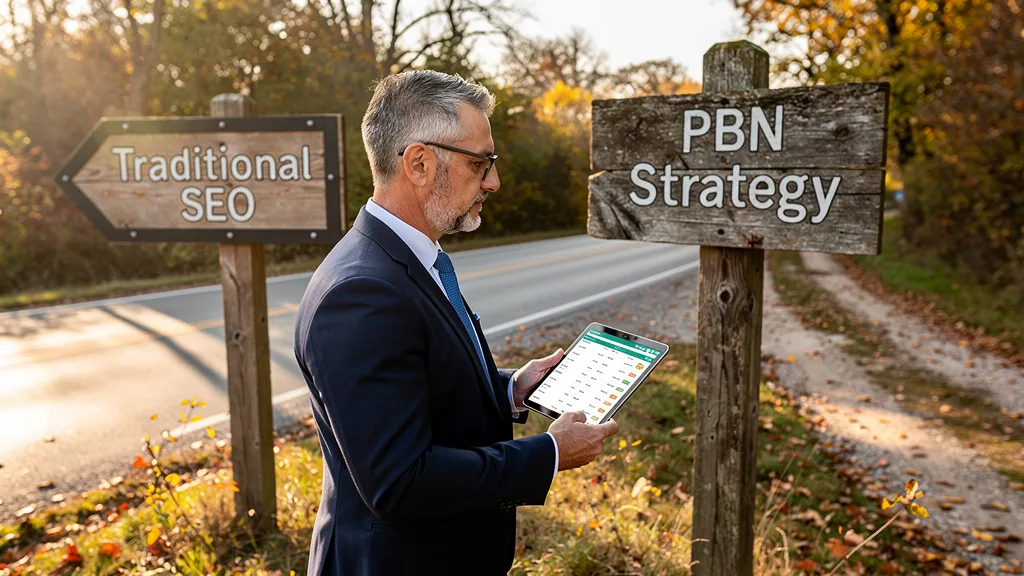
For most businesses, the sheer scale of building and safely managing a PBN is prohibitive. It's not a side project; it's a full-time job requiring deep SEO knowledge. Comparing the two approaches across key factors like cost, control, and risk management can help you make an informed decision that aligns with your business goals and resources.
Comparing Cost, Time, and Resource Investment
The upfront and ongoing costs of building a PBN are substantial. This includes purchasing dozens of expensive expired domains, paying for separate hosting plans, and investing in unique content for each site. The time investment is even greater, involving countless hours of domain research, technical setup, content management, and ongoing maintenance to ensure the network remains footprint-free.
Buying real estate backlinks from a service like Kamaal SEO transforms this capital and time expenditure into a predictable operational cost. You leverage an existing, professionally managed infrastructure without the steep learning curve and risk of costly mistakes. This allows your team to focus on core business activities like serving clients and closing deals, rather than managing a complex web of sites.
"For a busy real estate agency, the opportunity cost of building a PBN is immense. Their time is better spent on clients. Outsourcing advanced SEO to a trusted partner who lives and breathes this work daily delivers a far better ROI and significantly lower risk." - SEO Consultant
| Factor | Building Your Own PBN | Buying Real Estate Backlinks |
|---|---|---|
| Initial Cost | High (Domains, Hosting, Content) | Low to Moderate (Per Link/Package) |
| Time Investment | Extremely High (Hundreds of hours) | Minimal (Consultation & Reporting) |
| Required Expertise | Expert Level (Technical SEO, Footprint Management) | None (Handled by provider) |
| Risk Management | Solely on you | Managed by specialist provider |
| Speed to Results | Slow (Months to build network) | Fast (Links placed in existing network) |
Control Over Link Quality and Anchor Text
One of the primary arguments for building a PBN is the complete control it offers. You can hand-pick every domain, dictate every piece of content, and specify the exact anchor text for every link. However, this control is only valuable if you have the expertise to make the right decisions. Choosing the wrong domains or using overly optimized anchor text can do more harm than good.
When you work with a high-quality link provider, you are entrusting this control to seasoned experts. A professional service will work with you to develop a strategic Link Building Plan for Niche sites, ensuring that the links placed are powerful, relevant, and have a natural anchor text profile. You gain the benefit of expert-level control without needing to become an expert yourself.
Long-Term Scalability and Risk Management
As your real estate business grows, so will your SEO needs. Scaling a PBN to support that growth means continuously finding new domains, setting up more sites, and producing more content, all while ensuring the network remains secure and footprint-free. This becomes exponentially more complex and risky over time.
Purchasing links from a provider offers effortless scalability. As you need to increase your link velocity or target new keywords, you can simply scale your package. More importantly, the provider assumes the burden of long-term risk management. They are responsible for maintaining the health and security of the network, replacing any domains that lose value, and staying ahead of Google's algorithm updates. This model provides a sustainable, scalable path for long-term SEO success.
Who Should (and Should Not) Use PBNs for SEO?
PBNs are not a one-size-fits-all solution. They are a specialized tool best suited for specific scenarios and business profiles. For some, they can be a powerful catalyst for growth in a competitive niche. For others, they represent an unnecessary risk that could jeopardize their entire online presence. A clear-eyed assessment of your goals, resources, and risk tolerance is essential before proceeding.
Ultimately, the decision comes down to a business calculation. Is the potential reward of ranking for highly valuable real estate terms worth the inherent risks and costs associated with a PBN strategy? The answer will be different for a multi-city brokerage than for a solo agent just starting out.
Scenarios Where PBNs Might Be a Fit
PBNs are most viable for businesses operating in extremely competitive markets where traditional SEO tactics have hit a plateau. If you have a solid on-page SEO foundation, a healthy business, and a sufficient marketing budget, a PBN could be the lever that moves you to the top of the search results. This is particularly true in the real estate sector, where a single top ranking can be worth a significant amount of revenue.
This strategy is also a fit for businesses that are working with a trusted, expert provider who can demonstrate a track record of success and safety. If you have access to a team that manages PBNs professionally, mitigating the risks on your behalf, it becomes a much more calculated and manageable investment. It is an aggressive growth tactic for those who understand and accept the trade-offs.
When to Avoid PBNs and Focus on Other Strategies
If you are a new business, have a limited budget, or are highly risk-averse, PBNs are not the right choice for you. The potential for a catastrophic penalty outweighs the potential benefits. Your resources would be better spent on foundational SEO strategies like creating excellent local content, optimizing your Google Business Profile, and earning legitimate links through community outreach and digital PR.
Furthermore, if you do not have the expertise to build and manage a network yourself and are not in a position to hire a top-tier specialist, you should avoid this tactic. A poorly executed PBN is worse than no PBN at all. In these cases, focusing on safer alternatives like high-quality niche edits and link insertions or guest posting will build a more sustainable and resilient online presence for your real estate business.
Key Takeaways
Navigating the complexities of PBN link building for real estate requires a clear understanding of the core concepts. This advanced SEO strategy can deliver powerful results in a competitive niche, but it's not without significant risks. Here are the essential points to remember from this guide.
- High-Risk, High-Reward: PBNs offer unparalleled control over your backlink profile, potentially leading to rapid ranking improvements for valuable real estate keywords. However, they violate Google's guidelines and carry the risk of severe penalties if detected.
- Expertise is Non-Negotiable: Building and managing a safe, effective PBN requires deep technical knowledge to avoid leaving footprints. Every step, from domain acquisition to hosting and content, must be flawless.
- DIY vs. Professional Service: Building a PBN is a massive undertaking in terms of time, cost, and resources. For most real estate businesses, partnering with a specialist provider is a more efficient, scalable, and safer approach.
- Not for Everyone: This strategy is best suited for established businesses in hyper-competitive markets with a significant budget and a higher tolerance for risk. New or risk-averse businesses should focus on more traditional, safer SEO tactics.
Frequently Asked Questions
What are real estate backlinks?
Real estate backlinks are hyperlinks from other websites that point to your real estate agency's site, a specific property listing, or a blog post. These links act as votes of confidence in the eyes of search engines like Google. When a reputable website links to you, it signals that your content is valuable and trustworthy, which can significantly boost your search rankings.
How many sites should be in a PBN for a real estate website?
High-quality backlinks for real estate often come from relevant sources such as local news sites, home improvement blogs, mortgage and finance websites, or local business directories. The more authoritative and relevant the linking site, the more powerful the backlink is for your SEO. A strong backlink profile is a critical component of ranking for competitive real estate keywords.
Can you use one PBN to link to multiple real estate sites?
There is no magic number, as the ideal size of a PBN depends on the competitiveness of your target keywords and your budget. A small, powerful PBN of 10-15 high-authority sites can be very effective for targeting local real estate keywords. For more competitive national or major metropolitan markets, a larger network of 30-50+ sites might be necessary to achieve the desired ranking impact.
What are some safer alternatives to PBN link building for realtors?
The focus should always be on quality over quantity. A handful of links from strong, relevant domains with clean histories will provide more value and less risk than hundreds of links from low-quality, spammy sites. It's better to start small with premium domains and scale the network over time as needed.
How much does it cost to build a small real estate PBN in 2026?
Technically, yes, but it is extremely risky and generally not recommended. Using a single PBN to link to multiple money sites you own creates a massive, interconnected footprint. If one of your real estate sites gets penalized and traced back to the network, all other sites linked from that same PBN are at immediate risk of being penalized as well.
The best practice for safety is to maintain a strict one-to-one relationship: one PBN dedicated to one money site. This compartmentalizes the risk. Professional PBN management services maintain vast networks and use sophisticated methods to ensure there is no overlap between clients' link profiles, effectively isolating each client's site from others.
For realtors seeking lower-risk SEO strategies, there are several effective alternatives to PBNs. High-quality guest posting on real estate blogs, home design magazines, or local news websites is a great way to earn authoritative, contextual links. Another powerful method is obtaining niche edits, where you get a link added to an existing, aged article that is already ranking on Google.
Additionally, creating valuable local content that naturally attracts links, such as detailed neighborhood guides or housing market reports, can be very effective. Digital PR, which involves promoting unique data or stories to journalists, can also land you links from major publications. These white-hat strategies build long-term, sustainable authority without the penalty risks associated with PBNs.
Building even a small, high-quality PBN of 10 sites in 2026 involves significant costs. Quality expired domains with good metrics can cost anywhere from $100 to over $1,000 each. You'll also need separate hosting plans for each site, which can average $10-$20 per month per site. Finally, creating unique, quality content will cost at least $50-$100 per article.
A conservative estimate for a 10-site PBN would be an upfront cost of $2,000 to $5,000 for domains and initial content, plus ongoing monthly costs of $100 to $200 for hosting. This does not include the immense time investment required for research, setup, and management. Comparing this to the predictable cost of buying links from a service often makes the latter a more financially sound decision.
Conclusion
Ultimately, PBN link building for real estate is a double-edged sword. It offers a direct path to acquiring the powerful, niche-relevant links needed to dominate competitive search rankings, but it requires navigating a landscape fraught with risk. Success in 2026 hinges on flawless execution, deep expertise, and a constant focus on avoiding detectable footprints. For most real estate professionals, the complexity and high stakes make partnering with a specialist the only prudent way to leverage this powerful SEO tactic.
If your agency is ready to explore an advanced strategy to gain a competitive edge, it's time to talk to experts who manage these risks daily. We build and maintain penalty-free link building campaigns for some of the most competitive niches online, including real estate. Let our team assess your goals and create a safe, effective plan. To see how we can help you dominate your local market, Get a Link Plan today.