
Are you investing in PBN links but not seeing the ranking improvements you expect? The issue might not be the quality of your PBNs, but how the power from those links is being distributed. Understanding this is critical to ensuring your investment translates into tangible SEO results.
PBN outbound link dilution is the process where the ranking power, or link equity, from a page on a private blog network is divided among all the outbound links on that page. The more links a page has, the less authority each individual link passes to its destination, including your main website, often called the money site. This dilution can significantly weaken the impact of your link building efforts if not managed correctly.
At its core, PBN outbound link dilution is a simple concept of division. Imagine a PBN article has a certain amount of authority or ranking power to give. Every time you add an outbound link to that article, you are essentially cutting that power into smaller pieces. If your money site is just one of several sites being linked to, it only receives a fraction of the total potential power.
This happens because search engine algorithms, like Google's PageRank, are designed to distribute a page's value through its links. A page with 100 units of authority and 10 outbound links will, in a simplified model, pass 10 units to each destination. If it only has two outbound links, each destination receives 50 units. Therefore, controlling the number of outbound links on your PBN pages is fundamental to maximizing the SEO benefit for your target website.
Backlink Equity Explained: How Link Power Is Passed and Lost
To effectively manage dilution, you must first understand the mechanics of backlink equity. This term refers to the value or authority that a link passes from one page to another. It's the currency of link building, and like any currency, it can be spent wisely or wasted. A strong PBN link should act as a powerful endorsement, but its effectiveness is entirely dependent on how that equity is transferred.
Understanding the Flow of PageRank and Ranking Power
The concept of PageRank, though evolved, still forms the basis of how search engines perceive link value. A page accumulates PageRank from the links pointing to it and then passes a portion of that value on through its own outbound links. This flow of ranking power is not infinite. A PBN page with high authority has a significant amount of power to share, but it's a finite resource.

Think of it like a water reservoir. The reservoir (the PBN page) can be full of water (authority), but if you open multiple pipes (outbound links) at once, the pressure and volume flowing through any single pipe is greatly reduced. To get a powerful jet of water to a specific target (your money site), you need to close off the other pipes. This is why a dedicated PBN link with no other competing external links is so valuable.
Common Factors That Dilute Backlink Equity
Several factors can cause the value of your PBN links to diminish before it ever reaches your money site. Being aware of these common pitfalls is the first step toward creating a more efficient link building strategy. The most significant factor is simply having too many outbound links on a single page, which directly splits the authority.
Other diluting factors include linking to low-quality or irrelevant sites, which can devalue the PBN page itself. Even internal links on the PBN site, while necessary for site structure, consume a small portion of the page's total equity. While `nofollow` attributes prevent the direct flow of PageRank, their presence can still affect how the remaining equity is divided among the followed links on the page, making careful link management a necessity for any serious SEO campaign.
Calculating the Impact of Dilution on Your Money Site
Quantifying the exact impact of link dilution can be complex, as Google's algorithm contains hundreds of variables. However, you can use simplified models and tools to estimate the effect and make more informed decisions about your PBN strategy. The goal is to ensure the highest possible percentage of a PBN page's authority is directed exclusively to your money site.
The Math Behind Dividing Link Power
The original PageRank formula provides a basic model for understanding dilution. In this model, a page's PageRank is divided equally among all its outbound links. While the modern algorithm is more sophisticated, incorporating factors like link placement, anchor text, and user behavior, the core principle remains: more links equal less power per link.

To illustrate the effect of dilution, consider the following simplified scenario. A well-structured PBN page with only one link to your money site directs nearly all its transferable power there. Add just one more external link, and you've potentially cut that power in half. This table demonstrates how quickly the value diminishes as you add more links.
| Number of Outbound Links on PBN Page | Estimated Power Passed to Your Money Site | Dilution Effect |
|---|---|---|
| 1 (only to your money site) | ~90% (allowing for damping factor) | Minimal |
| 2 (money site + 1 authority link) | ~45% | Moderate |
| 5 (money site + 4 other links) | ~18% | High |
| 10 (money site + 9 other links) | ~9% | Severe |
Tools for Auditing Your PBN Link Profile
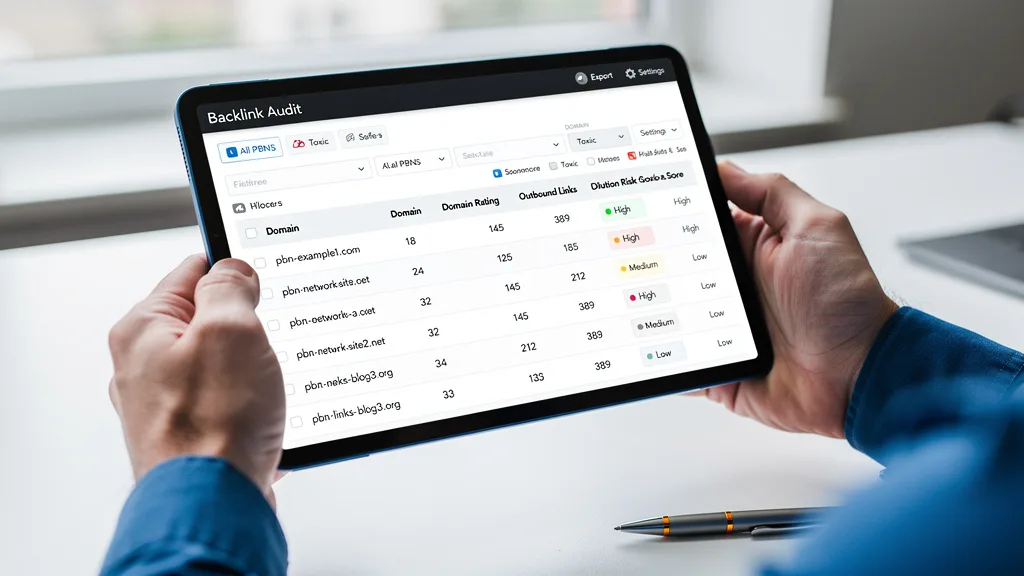
You don't have to guess how your PBNs are structured. Several industry-standard tools can help you perform a thorough website audit of your network. Tools like Ahrefs, Majestic, and Semrush allow you to crawl your PBN sites and analyze their outbound link profiles. You can quickly identify pages with an excessive number of external links that are diluting the power meant for your money site.
When conducting an audit, check each PBN article that links to you. Count the number of other external, dofollow links on that same page. If you find multiple links pointing to other money sites, or even just an excessive number of authority links, you are losing value. A regular audit is a critical maintenance task for anyone managing private blog networks to ensure a positive return on investment.
Strategies to Maximize Ranking Power and Minimize Dilution
Fortunately, PBN outbound link dilution is not an unavoidable fate. With a strategic approach, you can structure your PBN links to deliver maximum impact. These strategies focus on control, precision, and maintaining a natural appearance to search engines.
The most direct way to combat dilution is to strictly limit the number of outbound links on any PBN page pointing to your money site. The ideal scenario is a single, contextually relevant outbound link: the one to your website. This ensures that nearly the full authority of the page is channeled to your target URL.
"Think of each PBN article as a focused power conduit. Every additional outbound link you add is like drilling a hole in that conduit. A single, well-placed link to your money site ensures maximum ranking power is delivered without leakage."

While some strategies involve adding a link to a non-competing authority site to improve the page's perceived legitimacy, this should be done sparingly. Every external link is a calculated cost. If an article's sole purpose is to boost your money site, then every link should serve that primary goal. For a deeper dive into common errors, exploring PBN link building mistakes can provide valuable insights.
Using a Smart Structure for Internal and External Links
A smart structure for your PBN involves more than just external links. How you use internal links within the PBN site itself also matters. Internal links help distribute authority throughout the PBN, which can strengthen the entire network. However, on the specific page that links to your money site, even internal links can consume a small fraction of the total equity.
A common best practice is to have your most powerful PBN pages, often the homepage or pages with their own strong backlinks, link directly to your money site. Weaker internal pages can be used to support these power pages with internal links. This tiered approach helps consolidate authority on the pages that matter most, allowing them to pass more potent equity to your primary domain.
Strategically Linking to Non-Competing Authority Sites
While the primary rule is to limit outbound links, there is a strategic exception: linking to high-authority, non-competing websites. This practice, known as co-citation, can help your PBN page appear more natural and credible to search engines. A post that only links to one unknown site can be a red flag, but one that links to a money site and a relevant Wikipedia page or a university study seems more authentic.
The key is balance. If you choose to do this, limit it to one or two highly trusted sources that are topically relevant to your article's content. This small amount of dilution can be a worthwhile trade-off for the increased trust signals it sends. It helps your PBN blend in with the rest of the web, reducing the risk of being flagged as part of a manipulative link scheme. You can learn more about what is the meaning of PBN linking in SEO from community discussions.
PBN Footprints That Increase Risk and Weaken Links
Beyond dilution, the biggest threat to your PBN investment is detection. Search engines actively look for patterns, or "footprints," that indicate a group of websites exists solely to manipulate search rankings. When a network is identified, its links are devalued, and the sites it links to may be penalized. Avoiding these footprints is just as important as managing link equity.
Hosting, IP, and Domain Registration Patterns to Avoid
One of the most common and easily detectable footprints relates to the technical setup of your PBN. If all your PBN sites are on the same server, share an IP address or C-class IP block, or use the same domain registrar with identical WHOIS information, you are creating a massive red flag. Diversification is key.
Here are some technical footprints you must avoid:
- Shared Hosting Providers: Using the same budget SEO host for all your PBN domains.
- Common IP Addresses: Having multiple PBNs on the same or sequential IP addresses.
- Identical Domain Registrars: Registering all your domains through one company.
- Public WHOIS Information: Using the same contact details for every domain registration. Always use different privacy protection services.
- Consistent Name Servers: Pointing all your domains to the same set of name servers.
These are just some of the 10 PBN Footprints That Will Get You De-Indexed if you're not careful. Investing in premium, diversified hosting is non-negotiable for a safe and effective PBN strategy.
Content Quality and Uniqueness Signals
In 2026, content quality is a major ranking factor, and this applies to PBNs as well. Using spun, plagiarized, or thin content is a clear signal of a low-quality site. Each PBN should look and feel like a real, independent blog. This means publishing unique, well-written articles that provide some level of value to a reader.
Google's algorithms are incredibly sophisticated at detecting generated or duplicated text. A network of sites filled with nonsensical or repetitive content is easy to spot and de-index. Investing in unique content for your PBNs not only reduces risk but also strengthens the authority and relevance of the page, making the link it passes even more powerful. Proper setup and content are crucial, which is why a guide on PBN indexing and tracking configuration is essential for long-term success.
The Role of PBNs and Link Management in 2026 SEO
The conversation around PBNs in the SEO community is ongoing. While they are considered a grey-hat tactic and carry inherent risks, they remain a powerful tool for ranking in highly competitive niches when executed with precision. In 2026, the success of a PBN strategy hinges entirely on the quality of its management. Gone are the days of building large, cheap networks with spun content.
Today's effective PBNs are small, curated collections of high-authority domains that are managed to look like completely independent, legitimate websites. This requires a deep understanding of all the concepts discussed: managing link dilution, avoiding footprints, investing in quality content, and diversifying hosting. For many businesses, particularly in competitive sectors like finance or iGaming, using a specialized service for something like Finance PBN links is often a safer and more effective approach than attempting to build and manage a network in-house.
Key Takeaways
To ensure your PBN strategy is effective and safe, focus on these core principles. Mastering them will help you maximize the return on your link building investment and avoid common pitfalls that can lead to penalties.
- Dilution Is Real: Every outbound link on a PBN page divides its ranking power. To maximize impact, limit outbound links to the absolute minimum.
- One Link Is Ideal: For maximum power transfer, a PBN article should ideally link out only to your money site.
- Audit Your Network: Regularly use tools like Ahrefs to check your PBN pages for excessive outbound links that are wasting your link equity.
- Avoid Footprints: Diversify your hosting, IPs, domain registrars, and WHOIS information to prevent your network from being detected and devalued.
- Quality Over Quantity: In 2026, a small, high-quality PBN with unique content and careful link management is far more valuable and safer than a large, low-quality network.
Frequently Asked Questions
What does PBN stand for in SEO?
PBN stands for Private Blog Network. It is a network of authoritative websites that you control, used primarily to build backlinks to your main website (money site) for the purpose of improving its search engine rankings. These sites are typically built on expired domains that already have established authority.
Do PBNs still work for ranking in 2026?
Yes, PBNs can still be effective for ranking in 2026, especially in competitive niches. However, their effectiveness depends entirely on execution. They require meticulous management to avoid detection, including using high-quality content, diversifying hosting and IP addresses, and carefully managing outbound link profiles to prevent dilution and other red flags.
How many money sites can one PBN article safely link to?
For maximum safety and link power, a single PBN article should only link to one money site. Linking to multiple money sites from the same article not only causes severe PBN outbound link dilution but also creates an obvious footprint that makes the network easier for search engines to detect and penalize.
What are the three main types of backlinks?
The three main types of backlinks are Natural (or Earned) Links, which are given editorially without any action from the site owner; Manual Links, which are acquired through outreach efforts like guest posting or asking for links; and Self-Created Links, which are built by the site owner on platforms like forums, directories, or private blog networks (PBNs).
Is it safe to use a PBN for a brand new website?
It is generally not recommended to use PBNs for a brand new website. A new domain has no established trust or authority, and a sudden influx of powerful links from a PBN can look unnatural and trigger a penalty. It is much safer to establish a natural backlink profile first and consider PBNs only after the site is more established. A proper PBN site warm up period is critical even for established sites.
Conclusion
Understanding and controlling PBN outbound link dilution is no longer an optional tactic, it is a fundamental requirement for a successful and sustainable PBN strategy in 2026. By treating each link as a valuable asset and ensuring its power is directed with precision, you can transform your PBNs from a risky expense into a powerful driver of rankings. Focus on minimizing outbound links, avoiding technical footprints, and prioritizing quality to ensure your investment pays off.
Ready to build a powerful and safe link profile without the guesswork? Our experts analyze your needs and create a custom strategy that drives results. Get a Link Plan.